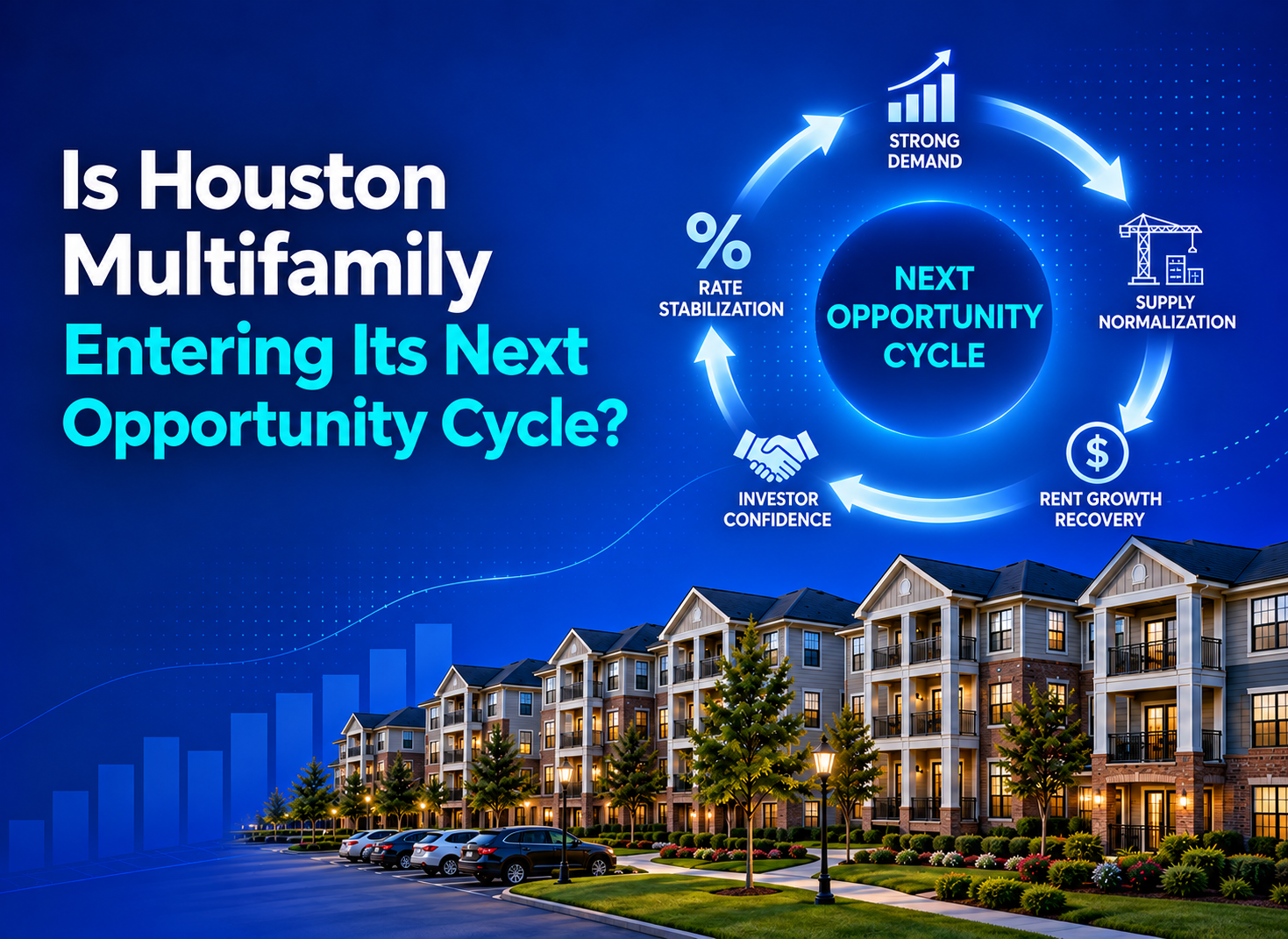
The August 2026 multifamily market presents investors with a mixed operating and capital-markets picture. National rent data point to modest improvement, but Houston remains under pressure on a year-over-year basis. At the same time, demand continues to favor select Houston neighborhoods, while cap rate expectations remain divided and financing execution is becoming somewhat more flexible.
For investors, the August 2026 multifamily market is less about identifying a single bullish or bearish signal and more about separating national trends from local realities. Location, achievable rents, operating discipline and conservative exit assumptions remain central to underwriting.
Houston Rents Remain Under Pressure Despite Positive National Growth
According to the CoStar August 2026 report, the average U.S. apartment rent reached $1,751 in August, down 0.03% month over month but up 1.3% year over year. Houston moved in the opposite direction on an annual basis, with rents 1.2% below the prior year.
That divergence is one of the more relevant signals in the August 2026 multifamily market. National annual rent growth has improved, but Houston apartment rents still reflect a more competitive leasing environment. For investors, national averages can provide context, but they should not be treated as a direct proxy for achievable rents at the property level.
Houston underwriting remains more dependent on the immediate competitive set, current concessions, renewal performance and the positioning of individual assets.
There is also an important counterpoint. Negative year-over-year rent growth does not necessarily mean Houston conditions are deteriorating at the same pace. As supply pressure moderates, the leasing environment could become more balanced. The current data, however, still support conservative rent assumptions rather than underwriting an immediate return to stronger pricing power.
Montrose and the Inner Loop Continue to Attract Multifamily Demand
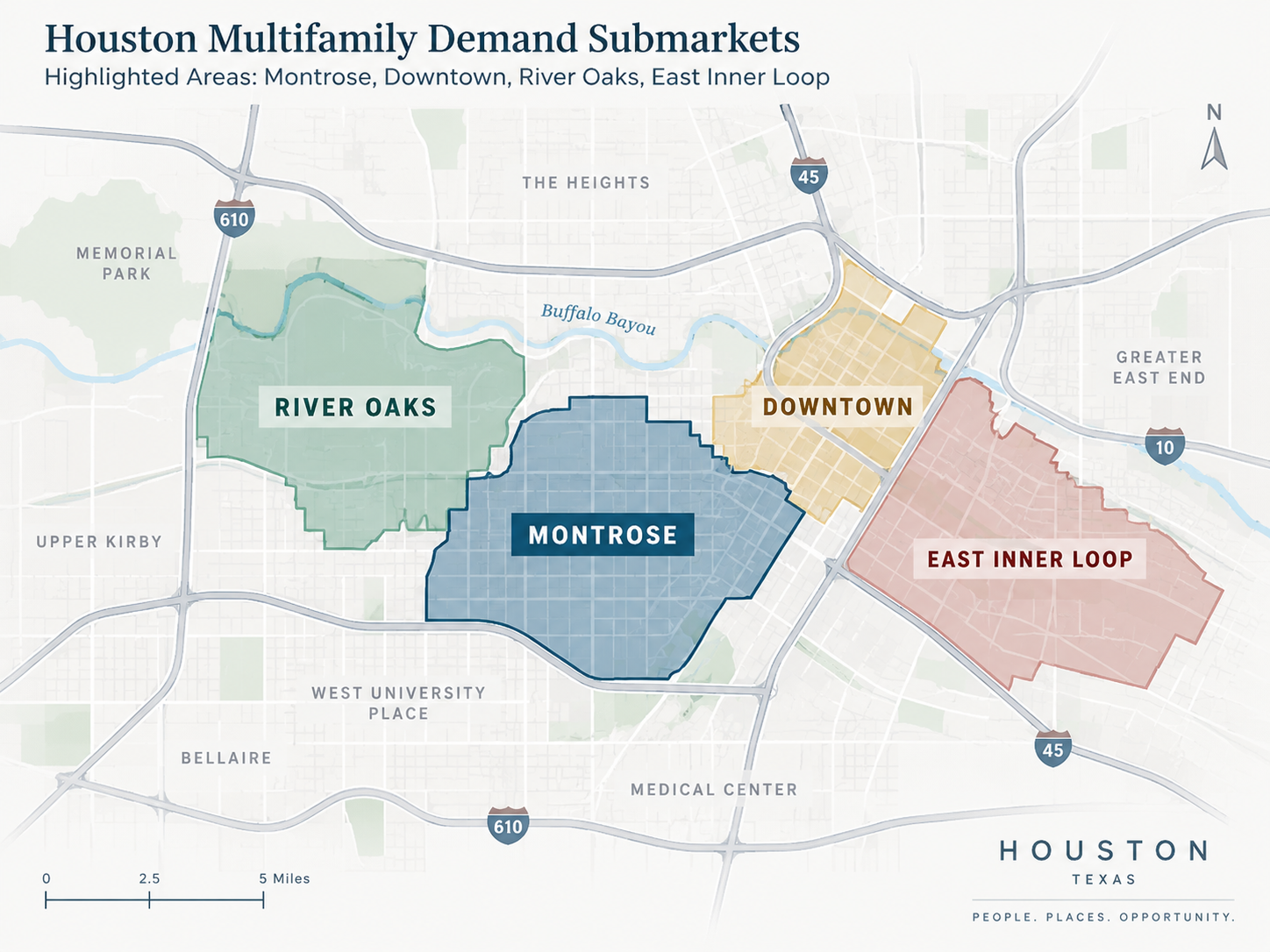
The CBRE Houston 2026 Midyear Review identifies Montrose, Downtown, River Oaks and the East Inner Loop among the strongest areas for multifamily demand. CBRE also expects resident retention and access to employment and amenities to support occupancy through the second half of 2026.
For investors reviewing the August 2026 multifamily market, this is an important distinction. Houston’s citywide rent figures do not describe every neighborhood equally. Demand remains concentrated in areas where residents have convenient access to employment centers, services and amenities.
Montrose is particularly relevant because it illustrates how location can provide a stronger demand foundation even when broader Houston rent growth remains challenged.
That does not mean strong location automatically produces strong investment performance. Asset condition, competing inventory, rent positioning, concessions, resident turnover and capital requirements all determine whether Montrose multifamily demand can translate into stronger property economics.
For investors, the signal is therefore not simply that demand is strong. It is that submarket selection matters more when citywide performance is uneven.
National Rent Trends Point to Stabilization, but Houston Still Requires Local Underwriting
The Yardi Matrix August 2026 National Report recorded a sixth consecutive month of rising advertised rents. Yardi cited resilient demand and slower supply additions as supportive of multifamily fundamentals and noted that some high-supply Sun Belt markets are showing signs of stabilization as lease-up inventories gradually decline.
This provides a more constructive national signal for the August 2026 multifamily market, but it should be read alongside CoStar’s Houston data rather than as evidence of a broad local recovery.
The two reports highlight different parts of the same market environment. National multifamily fundamentals may be moving toward better balance as new supply slows, while Houston still faces enough competition to keep annual rent growth negative.
For investors, the practical question is whether this stabilization is beginning to appear within a specific Houston submarket and competitive set. Evidence from current leases, renewals, concessions and occupancy should carry more weight in underwriting than national rent momentum alone.
Cap Rate Expectations Remain Divided
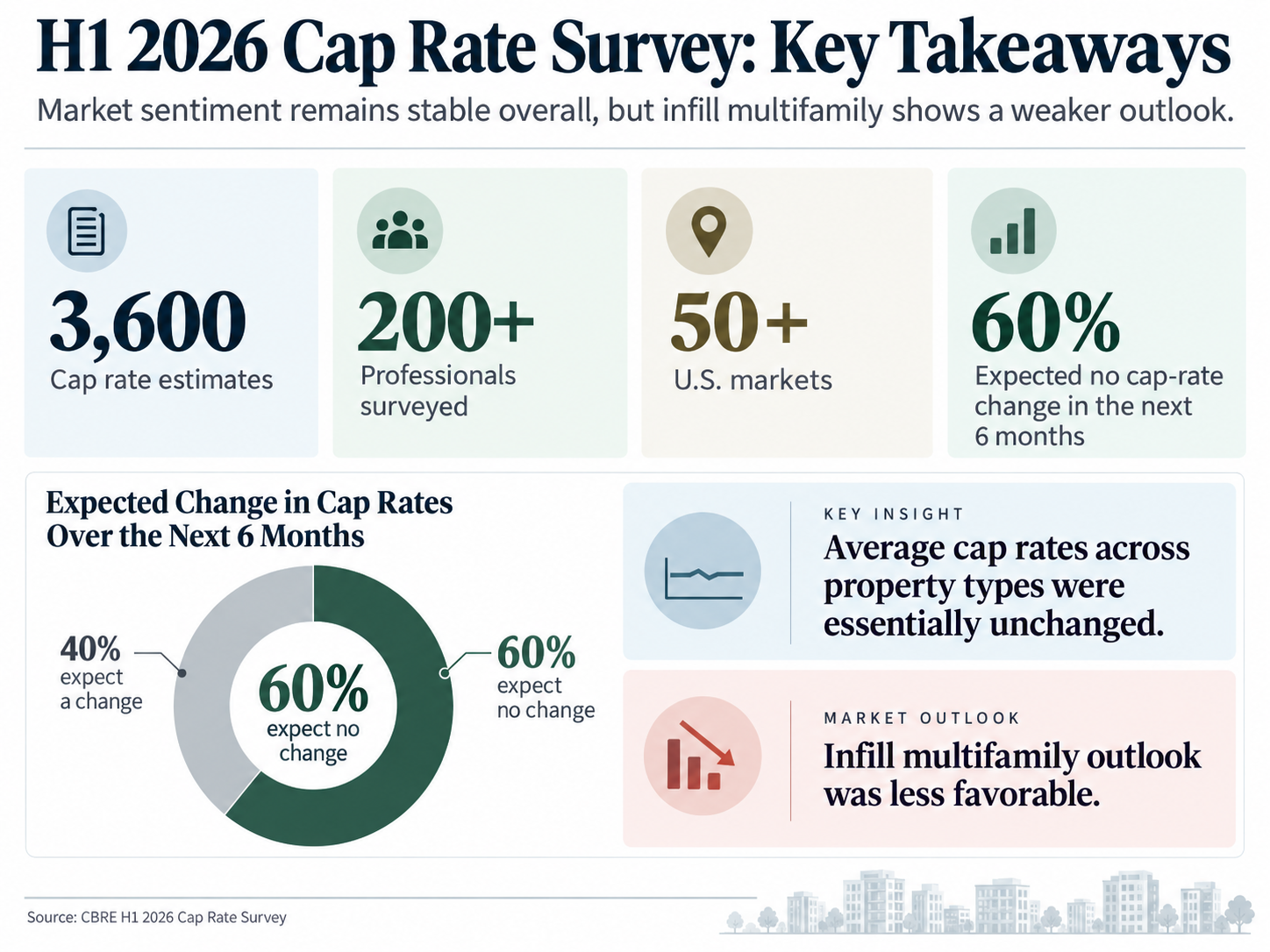
The CBRE H1 2026 Cap Rate Survey compiled approximately 3,600 cap rate estimates from more than 200 professionals across more than 50 U.S. markets. Average cap rates across property types were essentially unchanged, and roughly 60% of respondents expected no change over the next six months. At the same time, CBRE reported a less favorable outlook for infill multifamily.
That creates another layer of uncertainty in the August 2026 multifamily market. Stable average cap rates suggest that broad market repricing has not materially shifted, but the headline does not imply that cap rate compression is likely.
For investors, the underwriting implication is direct. An acquisition should remain viable without requiring a lower exit cap rate to support the investment case.
This is particularly relevant for Class B/C multifamily and value-add strategies. Targeted improvements and stronger operations can increase property-level NOI, but those operating gains should be evaluated separately from assumptions about future market valuations.
Purchase basis, achievable NOI growth and operating execution remain more controllable than where multifamily cap rates may be at disposition.
Fannie Mae Adds Flexibility to the Rate-Lock Process
According to Fannie Mae Lender Letter 26-07, the Fannie Mae Streamlined Treasury Lock allows eligible fixed-rate borrowers to lock the benchmark rate and hold the spread before completing a full rate lock. Updated documentation became mandatory on August 20, 2026 for loans using the feature.
For the August 2026 multifamily market, this is primarily a financing execution and interest-rate risk management development. It may provide eligible borrowers with more flexibility around the timing of the rate-lock process, but it does not represent a reduction in borrowing costs.
That distinction matters for investors. Financing flexibility can help manage transaction execution, but debt still needs to be sized around sustainable property cash flow, realistic interest expense and appropriate debt service coverage.
The process change should therefore be viewed as an execution tool rather than a reason to increase leverage or adopt more aggressive operating assumptions.
Investor Takeaway
The August 2026 multifamily market reinforces the importance of separating national momentum from local operating conditions.
National rents are showing signs of stabilization, but Houston remains below prior-year rent levels. At the same time, demand continues to favor well-located neighborhoods such as Montrose, Downtown, River Oaks and the East Inner Loop. That combination places greater emphasis on submarket selection and property-level competitive positioning.
Capital markets remain less definitive. Most respondents in CBRE’s survey expect cap rates to remain unchanged, but sentiment toward infill multifamily is less favorable. Fannie Mae’s rate-lock changes add financing flexibility without changing the underlying cost of debt.
For investors focused on the Houston multifamily market, the August 2026 multifamily market supports a disciplined framework centered on purchase price, achievable rents, thoughtful improvements and sustainable financing. Location can provide a stronger demand foundation, but durable property performance still depends on collections, concessions, operating expenses, capital requirements and realistic exit assumptions.
Integris remains focused on well-located Class B/C multifamily communities in Houston where targeted improvements and active management can strengthen the resident experience and operating performance. Montrose is particularly relevant to this focus. CBRE’s findings highlight demand for neighborhoods with convenient access to employment and amenities. We evaluate that appeal alongside each property’s condition, competitive position, and capital needs.
Our September thesis centers on a disciplined purchase price, achievable rents, thoughtful improvements, and sustainable financing. Together, these factors shape whether an attractive location can support a sound investment. We look forward to sharing more about our Houston investment focus in the coming weeks.